Quick answer
When you’re handed a traffic ticket you generally have three choices:
- Pay the ticket
You plead guilty. Easy, fast, but you take the hit: fines, points, and likely higher insurance.
- Fight the ticket (contest)
You say “not guilty” and try to get the charge dismissed or reduced. This can avoid points and big costs, but it takes time or help.
- Use a deferral / traffic school / diversion program
Many states offer a way to avoid a conviction if you meet conditions (finish a course, probation, or stay ticket-free). Rules vary by state.
Below we explain the pros and cons of each choice, how to fight the ticket, and why using Off The Record (OTR) is usually the best, least stressful option.
Option 1: Pay the ticket (Plead guilty)
Paying the ticket is the simplest option, but it is also the worst option for most drivers. When you pay a traffic ticket, you are pleading guilty. That means:
- The violation goes on your driving record
- You may receive points on your license
- Your insurance premiums may increase for 3 to 5 years
- Future tickets may carry harsher penalties because of this one
Many people pay their ticket because they think it is the easiest path. But the long-term cost of higher insurance premiums alone can far exceed the cost of hiring a lawyer to fight it.
We hear from drivers every day who paid a ticket a few months ago and are now reaching out because their insurance premiums went up significantly. They want to go back and contest the ticket — but unfortunately, once the ticket is on your record and your insurance company finds out, there is very little anyone can do to help.
The time to fight your ticket is now, not after the consequences hit.
Option 2: Fight the ticket (Plead not guilty)
You have the right to contest any traffic ticket. When you decide to fight, there are 3 ways to go about it:
Fight it yourself
You can go to court on your own and build your own defense. The success rate here is about 50% — essentially a coin toss. Most people do not know proper court procedures or how to present a legal defense. The outcome often depends on the mood of the judge and prosecutor that day, not the strength of your case.
Hire a lawyer on your own
You can find and hire a traffic attorney directly. The success rate improves to about 75–80%. But when you hire a lawyer on your own, you are locked in to that one attorney. If they are not the best fit for your court or charge type, you are stuck. And if something goes wrong, you are on your own.
Book a case with Off The Record
When you book with OTR, you get the best of all worlds:
- A 97% success rate across 500,000+ cases
- SmartMatch connects you with the attorney most likely to win your specific case in your specific court
- A money-back guarantee on eligible traffic tickets — if we are not successful, you get a full refund
- A cancellation policy that lets you cancel within 1 business day for a full refund
- Competitive legal fees — and we will price match if you find a lower fee for the same service
- A dedicated support team that manages your case from start to finish
With OTR, it is easier to fight a ticket than to pay it.
Option 3: Use a deferral or diversion program
Most states offer some kind of program that can reduce or eliminate the impact of a traffic ticket. These programs go by different names depending on the state — deferral, diversion, traffic school, defensive driving — but they all share a similar idea: complete a requirement (like a class or a ticket-free period) and the ticket may be kept off your record.
Here are a couple examples:
- Washington: Deferral Program
The court will defer an eligible ticket for up to 1 year. If you stay ticket-free during that period, the infraction is dismissed. A fee of around $150 is usually required, and this option is typically available only once every 7 years.
- California: Traffic School If eligible (usually once every 18 months), you can pay the fine plus a fee and attend traffic school. This keeps the point off your public record.
These programs can be helpful, but they have limits:
- Not all violations are eligible
- You can usually only use them once within a set number of years
- They are typically not available to CDL drivers
- Some require you to pay the fine first, with the points masked only after completing the program
- You still have to complete the program requirements — whether that means taking a class, performing community service, or driving without any new violations during a probation period. If you do not follow through, the original ticket goes back on your record.
A deferral program can be a reasonable option for any eligible ticket. But because you can only use them so often, savvy drivers treat them as a backup plan. The smarter strategy is to contest the ticket first — and only use your deferral if the not-guilty plea does not work out. That way, you save your one-time deferral for a ticket that truly cannot be beaten.
How the options compare
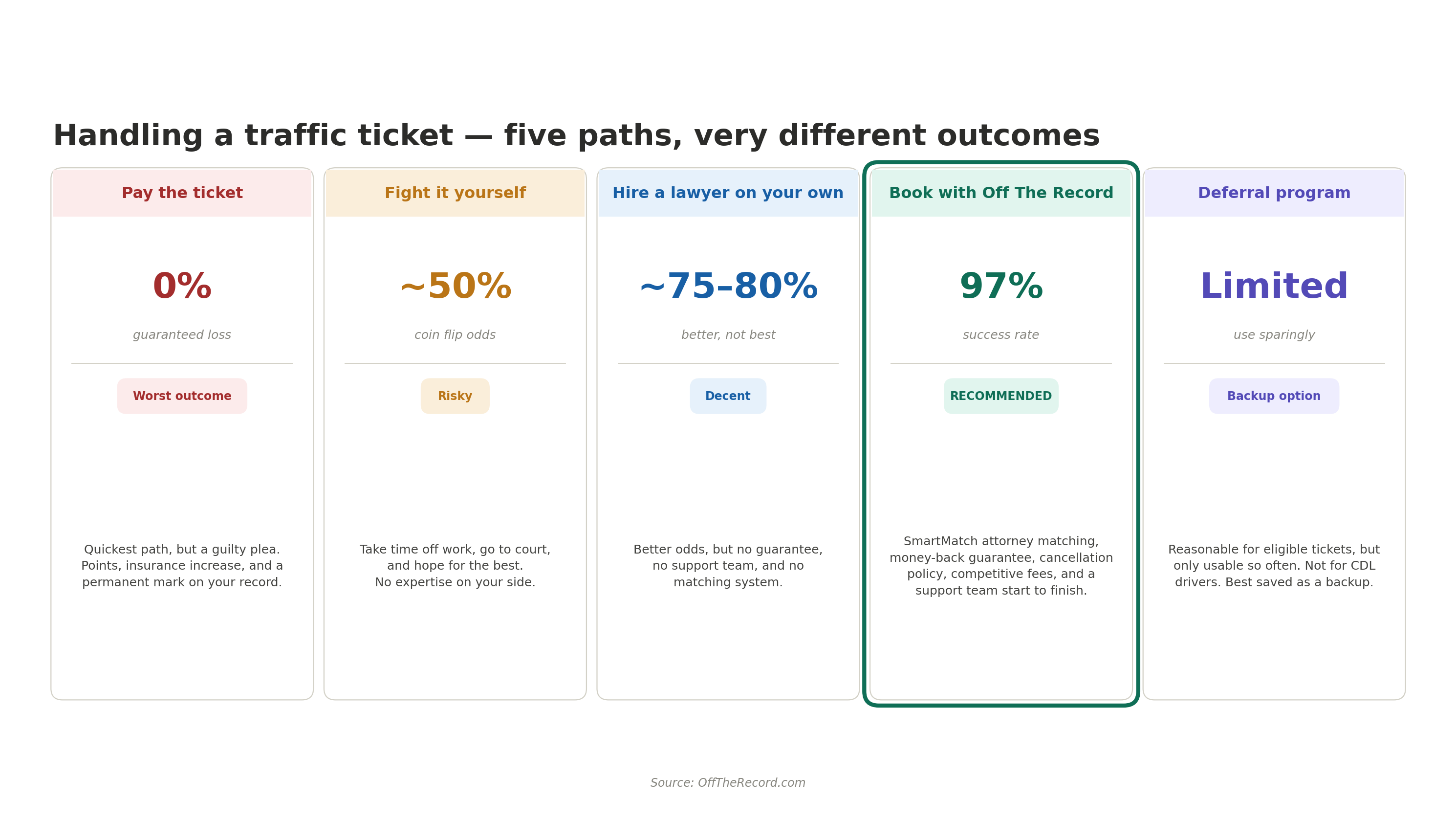
| Option | Success rate | Pros | Cons |
|---|
| Pay the ticket | 0% (guilty plea) | Quickest resolution | Points, insurance increase, permanent record |
| Fight it yourself | ~50% | No legal fees | Time off work, court appearance, no expertise |
| Hire a lawyer on your own | ~75–80% | Better odds than solo | No guarantee, no support team, no matching system |
| Book with Off The Record | 97% | SmartMatch attorney matching, money-back guarantee, cancellation policy, competitive fees, full support team | — |
| Deferral program | Varies | Reasonable for eligible tickets | Limited use, not for CDL drivers, requires class / community service / probation. Best saved as a backup. |
Our recommendation
If you have a traffic ticket, the smartest move is to fight it. And the easiest, most effective way to fight it is with Off The Record.
You can book your case in minutes, get matched with an experienced local attorney, and know that your case is backed by a 97% historical success rate and a money-back guarantee. It is faster, simpler, and more affordable than most people expect.
With OTR, it is now easier to fight a ticket than to pay it.
Ready to try OTR?
Visit our booking wizard to enter your ticket details and get an instant quote.
You’ll take a photo of your ticket, and follow the steps to get matched to a lawyer who will review your case and explain the next best move for your state and ticket.


