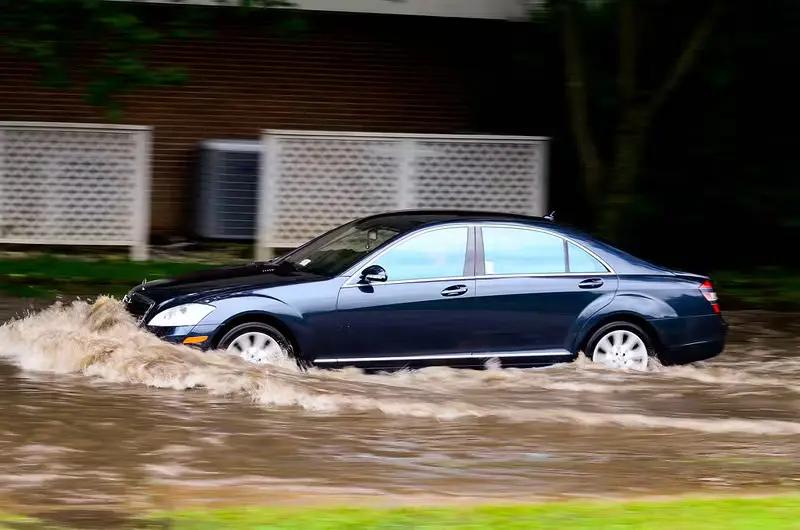
At some point, all of us who drive make the decision about whether to try and drive our vehicle through water. It’s probably safe to say that most, if not all, drivers have taken the risk at some point. And, turns out, driving through water truly is a risk. You risk damaging your car. You risk possibly damaging the property of another person. You risk getting stranded. In certain circumstances, you risk your safety and even your life. No doubt, you’ve watched the sensational videos of stranded drivers who must be rescued by the police or fire department and, worse, the videos of cars being swept away with the driver and passengers still inside of it.
It may seem like a crazy thought, but it doesn’t take nearly as much water as what you think to cause your car to float or to cause damage to your vehicle. According to AAA:
- Most people who get stranded after driving through water drown just nine feet away from what would be considered a safe spot for them to reach.
- 32% of all flood-related deaths happen in vehicles.
- It takes less than six inches of fast-moving water to knock you off your feet and makes it hard to stand back up.
- If the water is moving at 4 MPH, anyone who is standing in it, regardless of their size or strength, will be knocked off their feet.
- It takes less than two feet of standing water (24”) to make a car float, this includes trucks and SUVs.
- It only takes 11” of flowing water to move a car.
If you’re wondering why so many drivers seem to get stranded (or injured and lets not even talk about the damage to their vehicle) after driving through water, there are a few reasons. First, it can be difficult to tell how deep water actually is. Second, depending on the conditions, it could be difficult to tell whether the water is standing or flowing. Third, it doesn’t take much water to cause a vehicle to stall out. AAA states on their website that it takes less water than the size of an egg to cause a vehicle to stall. Fourth, the conditions can hide structural issues on the road caused by the flooding. These structural issues can range from something as minor as a new pothole that compromises your tire to a portion of a bridge or road being entirely washed out.
Driving through water can cause serious damage to your vehicle. Here are just a few common problems that can result from driving through water: engine misfires, the reduction in engine power, the engine stalling out, damage to the clutch, water in the exhaust system, damage to the brakes and rotors, damage to the vehicle’s electrical system, and, even damage to the spare tire depending on where it is located. According to some experienced experts and car enthusiasts if your car has an air intake on the bottom, driving through water can ruin your engine.
Driving Through Standing Water
Standing water is water that does not move. Standing water in a road could be caused by a heavy downpour that results in flash flooding, a heavy storm that stalls over an area, a hurricane, a tropical storm, flooded riverbanks and lakes, or even broken fire hydrants or city water mains. Standing water occurs because there is nowhere for the water to go. Low lying areas and areas without sufficient drainage systems are prime targets for standing water. However, even areas with better drainage systems could have standing water in a flash flood.
Before driving through standing water strongly consider whether you need do it. Even for tall vehicles such as trucks and SUVs, it doesn’t take much water to make your car float, damage or ruin an engine, or affect your braking system. Water hitting the undercarriage even of tall vehicles could find a way through and affect electrical components that may be located in the floorboard of your vehicle.
If there is an emergency and you must drive through standing water, consider the depth of the water. Do not drive into water that is more than four inches deep. If there is a medical emergency, call 911. First responders are better equipped to drive through standing water than you. If the water is less than four inches in depth, don’t drive through the water if there is another car driving through it. Wait for that car to fully pass through the standing water before you enter it. This helps protect your car from being exposed to waves of water that may not have occurred if you drove through without the other vehicle. Keep your pace slow and steady, at no more than 5 MPH. Going slow can protect your engine from serious damage. Look for potential hazards before you drive. Depending on whether you’re driving in an urban or rural area, there could be missing manhole covers as well floating pieces of rock or concrete. If your car sits lower to the ground, never drive through standing water that is higher than the middle of your tires.
To help keep your car pulling at a slow, steady pace, put your car into a low gear. If you drive an automatic, look at your gear shift. You should have the option for 1 or 2. It may also say L or 2. If you do stall out, try not to panic. Instead, call for help. If you don’t have an emergency, you could call your insurance company if you have a towing endorsement.
Finally, check your brakes as soon as you can after driving through standing water. You can do this by lightly using your brakes while you drive in areas without standing water and by driving slower than usual. When in doubt, get your brakes checked by a mechanic.
Driving Through Deep Water
Driving through deep water should be avoided regardless of whether it is standing or moving. Deep water could be caused by several factors. One of the most common factors being a continued deluge of rain that comes quickly in an area. It won’t matter if the area has decent drainage. The water will rise. Driving through deep water is dangerous for many reasons.
Deep water should be considered contaminated. Because it takes longer for the water to drain, stagnation, dead animals, chemicals used in gardens or on farms, animal waste, and even trash can get into the water. This could make you sick. If you have a weakened immune system, it could cause serious health issues. If your children are with you, it could get into open wounds or even into their ears, nose, or mouth.
Driving through deep flood water makes it more likely that you could run into a road hazard. Fast moving deep water, be it moving down the road or falling from the sky, could cause weakened structures, such as a previously damaged sidewalk, curb, or driveway, to break. It could cause the instant formation of giant potholes, the type that are large enough for an entire car to fall in. Manhole covers could also float in the water. It could be next to impossible for you to spot…until you find it the hard way.
Deep water increases the likelihood that your vehicle could be swept away if the water is moving. As discussed, it takes less than one foot of water to move a vehicle, including a truck or an SUV. It’s important to always follow the same best practices as with driving through standing water. Don’t drive through the water unless it is absolutely necessary. If you have an emergency, call 911 for assistance. If you do drive through deep water, keep your speed to less than 5 miles per hour. Getting through the water faster doesn’t necessarily protect you from having your vehicle swept away. It does the opposite. It could cause you to hydroplane and lose control of the steering. This increases the likelihood that your vehicle could be swept away. Do not try to speed around other vehicles driving through deep water. It creates waves that could cause damage to your vehicle, the other vehicle, and could cause both vehicles to get swept away.
Driving through deep water increases the risk of damage to your engine, brakes, the air intake, and the electrical system in your vehicle. This increased risk exists even for high profile vehicles. Some of the air intake system could be underneath the vehicle. Additionally, water that gets under the vehicle could soak in and damage any electrical components that are housed in the lower part of the vehicle.
Again, if you must drive through water watch your vehicle for signs of damage, such as a sputtering or misfiring engine or problems with your brakes. Get a mechanic to look at your vehicle as soon as you can. But, remember, do not drive through deep water if at all possible.
Truck Driving Through Water
You’ve seen a truck driving through water before. Or maybe you were that person driving the truck through water. The general thought is that since most trucks have bigger engines and are higher off the ground than other types of passenger vehicles that they’re more protected from the damage that could be caused by flood water. Yet, the size of the vehicle means very little. Keep in mind that it takes only two feet of water to pick up and carry a truck or an SUV.
If you do plan to drive your truck through water, play it smart. Do not drive through quickly and cause waves. The water that goes beneath your truck could enter your air intake or even soak into crevices that allow the water to damage certain electrical components of your truck. The water can also damage your exhaust system as well as your brakes and rotors. Yes, we know that TV commercials make a truck driving through water seem totally normal, but those scenes are extremely controlled environments that don’t represent real life flooding.
You won’t necessarily know the minute your truck exits the water that you have a big, expensive problem on your hands. Days or even weeks later , your brakes could fail. Within a few hours, water that managed to mix into your oil could cause your truck engine to knock and seize up. And we didn’t even mention the floating hazards. We’re sure you know how much it costs to buy tires for your truck and to get it aligned. Deep water or driving too quickly through flood water could mean that you don’t see a hazard until it’s too late.
Whether you drive a car, a truck, or an SUV, we want you to follow the age-old advice: “Turn Around Don’t Drown.” There’s no guarantee that you’ll make it through the water without getting hurt, the hazards that you may not see, or the serious damage that you could cause to your vehicle.
This information on this site is provided solely for informational purposes. It is not legal advice. Off The Record is not a law firm, does not provide legal services, and is not a lawyer referral service. The attorney listings on the site are paid attorney advertisements. Off the Record has not evaluated this content for accuracy, completeness, or changes in law. No representation is made here about your specific rights. Off The Record is not a substitute for an attorney or a law firm. Legal advice can only be provided by a licensed lawyer.

 Off the Record